
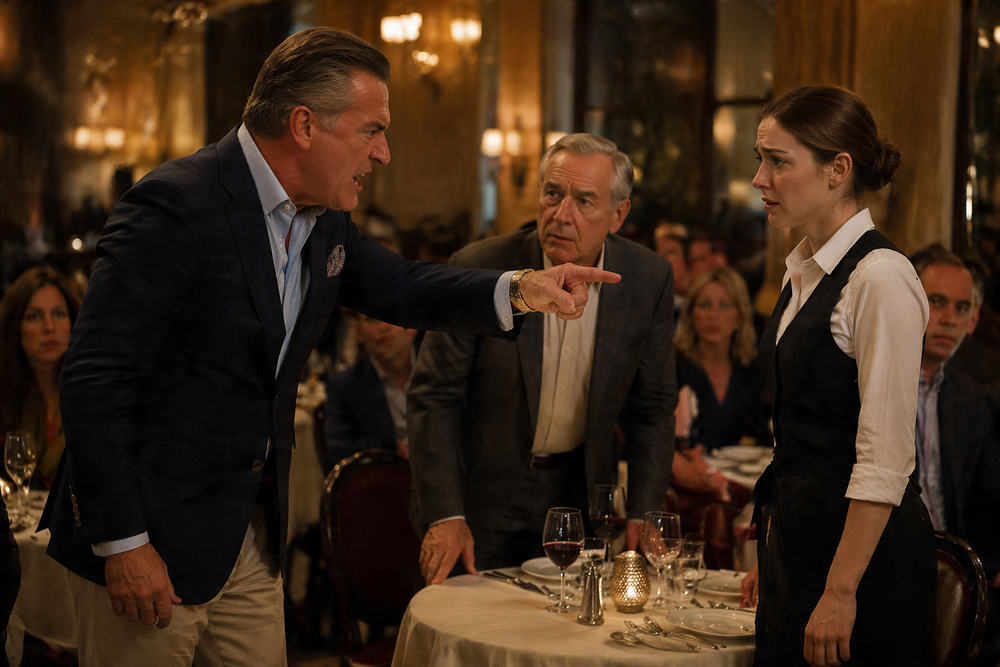
The man at table fourteen wanted everyone in the restaurant to know how important he was.
He had been loud since he sat down — about the wine, about the table, about the wait. So when the young waitress, hurrying past with a full tray, let a few drops of red wine splash the cuff of his jacket, he shot up out of his seat like she'd struck him.
"Are you blind?" His voice cut across the entire dining room. Forks stopped mid-air. "This jacket costs more than you make in a month. Do you have any idea who I am?"
"Sir, I'm so sorry — let me—"
"Don't touch me." He snapped his fingers at the air. "Get me the manager. Now. I want her fired. Tonight."
Her name was Clara. She was twenty-two. Her hands were shaking as she set the tray down, and the whole elegant room watched her be turned, in a matter of seconds, into something small.
The manager came hurrying over, already apologizing, already glancing at Clara the way you glance at a problem you're about to remove. The man at table fourteen only got louder with an audience — calling her clumsy, calling her stupid, saying that people like her shouldn't be allowed to work in a place like this at all.
Clara stared at the floor and tried not to cry. Crying would make it worse. And if she lost this job, she didn't know how she would get through the month.
At table six, by the window, an older man had been eating alone. Grey suit, no fuss, a single glass of water. He had been there most of the evening — quiet, unremarkable, easy to overlook.
He set down his fork.
Then he stood up.
The room turned again as he crossed the floor toward table fourteen, unhurried, calm, a man in no rush at all.
"That's enough," he said.
The rich man blinked. "Excuse me? This doesn't concern—"
"I've been sitting right over there for two hours," the older man said, "and I've watched you treat every single person who came near you as if they were beneath you. The valet. The busboy. And now a girl who spilled three drops of wine and apologized twice." His voice never rose. That was what made it land. "You keep demanding to know if people recognize who you are. I don't think that's your problem." A pause. "I think your problem is that you know exactly who you are. And you can't stand it."
The dining room was dead silent.
The rich man's face went red, then uncertain. He looked around for someone — anyone — to take his side, and found, for the first time all night, that nobody would meet his eyes.
He threw some bills on the table and walked out.
The older man turned to Clara, and his whole manner softened.
"Are you all right?"
She nodded, not trusting her voice, mortified now for an entirely different reason.
He gestured to the empty chair across from him. "Sit for a minute. The room can spare you."
She shouldn't have. She did.
He didn't pry. He just asked, gently, how long she had worked here — and somewhere in answering, she let it slip that this was her second job tonight, that she had a third on the weekends. That she was twenty-two and tired in a way twenty-two shouldn't be.
"It's for my brother," she said, before she could stop herself. "Danny. He's nine. He's sick — his heart. He needs a surgery. There's one surgeon who can do it, but the waitlist is over a year, and even if we ever reached the front of it, we couldn't…" She stopped, and shook her head. "I'm sorry. You don't need to hear all this."
The old man had gone very still.
"What's his name?" he asked quietly. "The surgeon who can do Danny's operation."
Clara told him.
And the old man smiled — a small, tired, almost sad smile — and took a pen from his jacket, and wrote something on a clean napkin, and slid it across the table to her.
She looked down.
The name she had just spoken — the surgeon at the top of the impossible waitlist, the one they could never reach and never afford — was written there on the napkin in careful blue ink.
And beneath it, in the same hand:
Bring Danny to my office Monday. 8 a.m. No charge. — H.B.
She looked up slowly. At the quiet man at table six. The plain grey suit. The single glass of water.
"You're—" She couldn't finish it.
"I don't usually tell people where I eat," Dr. Harold Bishop said, rising and leaving far more than enough cash for both their meals. "I just wanted one dinner where nobody needed anything from me." He looked at her, and something in his face had changed. "I'm glad that tonight, somebody did."
Danny had his surgery that month.
He's eleven now. He plays soccer — badly — and shows off the scar down his chest to anyone who'll look.
And every Thursday, a quiet older man in a grey suit comes into the restaurant and asks for one table by the window.
Table for one.
He always sits in Clara's section.
She has never once brought him a check.
No comments yet. Be the first reader to comment on this story.