
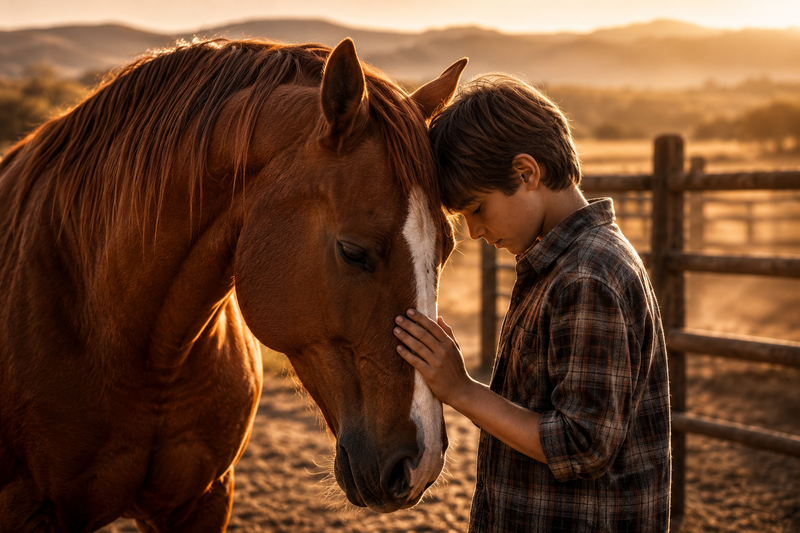
The chestnut mare at Willow Bend had thrown every rider who tried her and was bound for the kill auction that Saturday, and the only living soul she'd let near her was the boy who hadn't spoken a word in two years — until the morning he finally did, and everyone learned why the horse had chosen him.
The mare's name was Ember. The boy's name was Eli.
Willow Bend was a therapy ranch in the hill country outside Kerrville — the kind of place where kids who carry things too heavy for kids come to sit on patient horses and slowly put themselves back together. It ran on donations and good will, both of which had run thin, and that spring the owner, a weathered woman named Sandra, had to face the math. She was selling off the horses she couldn't place. Ember topped the list.
Ember was beautiful and dangerous. A chestnut mare with a white blaze, she'd come to the ranch two years before with no history anyone could verify, and she would not be ridden. She tolerated no saddle, no rider, no hand on her flank. Three experienced trainers had been thrown. She wasn't mean, exactly — she just carried something, the way some horses do, a grief or a fear locked in her big body that no one could reach. A therapy ranch can't keep a horse that hurts people. So Ember was going to the Saturday auction, where the only buyers are the ones who buy by the pound.
And then there was Eli.
Eli was nine. He'd come to Willow Bend after the accident — a wreck on a wet road two years before that had killed his father and left Eli, in the back seat, physically unhurt and completely silent. He had not spoken a single word since the night his father died. Selective mutism, the doctors called it; trauma. His mother, Dana, had tried everything. Speech therapists, counselors, medication. Nothing. The boy moved through the world behind glass.
She brought him to Willow Bend because someone said horses sometimes reached children that words couldn't.
The first day, Eli walked the line of stalls, and every horse but one greeted him with the easy curiosity of therapy horses used to nervous kids. The exception was Ember. She'd flattened her ears at every adult who'd approached her for two years.
She put her head over the stall door and lowered it to the silent boy and went completely still.
Eli reached up and touched the white blaze on her face, and the dangerous mare let out a long breath through her nose and leaned into his small hand, and Sandra, watching from across the barn, felt the hair stand up on her arms.
After that they were inseparable. Eli came every day after school. He couldn't ride her — nobody could ride her — but he didn't try. He just sat with her, brushed her, slept against her in the straw on the bad afternoons. The mare who would let no one near her stood guard over the boy who could not speak, and the two of them shared a silence that seemed to do for both of them what no person had managed.
Then the auction date came.
Sandra hated it. But she'd run out of room and out of money, and a horse that throws riders has no place at a therapy ranch, and there was nothing to be done. Saturday morning the trailer came. Dana brought Eli to say goodbye, because she couldn't bear to take that away from him too, even knowing it might break him.
Eli walked into Ember's stall. He put his arms around the mare's neck. The men with the trailer waited by the gate.
And the boy who had not spoken in two years opened his mouth.
"Don't take her," Eli said. His voice was rusty, cracked, barely a sound. But it was words. Real words, the first in two years, and the whole barn froze. "Don't take her. She was there. She remembers too."
Dana dropped to her knees. "Baby — Eli — what do you mean, she was there?"
Eli pressed his wet face into the mare's neck.
"The night Daddy died," he whispered. "On the road. There was a trailer. It tipped. There was a horse on the road in the rain. Daddy swerved so we wouldn't hit her." He was crying now, two years of it. "It was her, Mama. The blaze. I saw the white on her face in the headlights. She got loose and she was on the road and Daddy turned the wheel so we wouldn't hit her and that's why — that's why —"
He couldn't finish. He didn't have to.
Sandra was already moving for the office, for the file, for the one piece of paper she had on the mare with no history: a transfer note from a livestock hauler, two years old, a chestnut mare recovered after a highway incident, loose on the road, the only survivor of an overturned trailer on a wet night, brought in unclaimed and skittish and unrideable ever since.
The date matched. The road matched.
The horse Eli's father had died swerving to avoid was the horse who had spent two years refusing every human hand — except the hand of the boy from the back seat of the car that swerved. She'd carried the same night in her body that he carried in his. Two survivors of the same rain, the same headlights, the same swerve, found each other across two years of silence and recognized in each other the only one who understood.
She hadn't let anyone ride her because she'd been waiting. She just hadn't known for whom, until a silent boy reached up and touched the white blaze that was the last thing his father ever saw.
The trailer left empty.
Ember never went to auction. Sandra found the money somehow, the way you find money for the things that matter, and the mare stayed at Willow Bend. Eli kept coming. He kept talking, too — slowly at first, then more, the words returning like water finding an old riverbed.
He learned to ride her that summer. She let him, and only him. The horse nobody could ride carried the boy who couldn't speak out across the hill country in the long gold evenings, and the two of them got better together, at the same pace, the way you heal when you finally find the one other soul who was there.
Dana stood at the fence and watched her son ride the horse her husband had died to spare, and she understood that grief had given something back, in its own strange and roundabout way — that the swerve in the rain had bought two lives that night, not none, and that both of them had finally found their way home to each other.
On the anniversary, every year, Eli rides Ember out to the ridge at dusk and they watch the light go down together. He talks to her the whole way. He never runs out of things to say anymore.
She was there. She remembers too. And now neither of them has to remember it alone.
No comments yet. Be the first reader to comment on this story.