
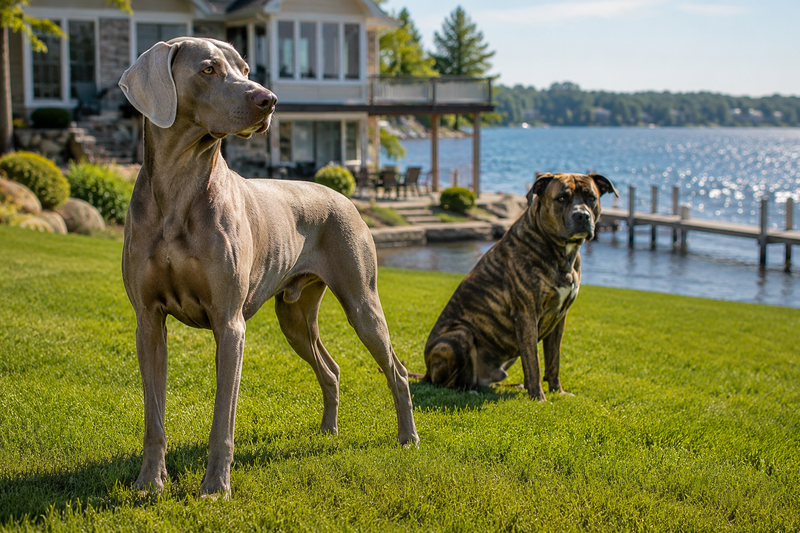
Preston Vance spent eleven thousand dollars on a champion-bred Weimaraner and called the shelter mutt his daughter rescued an embarrassment, right up until the afternoon the lake nearly took his son and only one of those two dogs went in after him.
The mutt's name was Biscuit. Nobody knew what he was made of.
Preston Vance was the kind of man who bought the right things. The right car, the right watch, the right house on the right side of Lake Carraway, and — when his wife wanted a dog — the right dog: a silver Weimaraner named Duke, papered back four generations, a ribbon winner before he was a year old. Duke was beautiful and cost more than most people's cars and was, Preston liked to say, an investment.
The mutt had been his teenage daughter's doing.
Cara had come home from the county shelter in tears over a brindle dog nobody wanted, some shepherd-pit-something with a blocky head and a stub of a tail and one ear that wouldn't stand up. She'd begged. Her mother had relented while Preston was traveling, and by the time he got home the thing was already named and already on the couch, and there was no getting rid of it without making his daughter cry, which his wife would not allow.
So they had two dogs. The investment, and the embarrassment.
Preston never let anyone forget which was which. At the Lake Carraway club he showed Duke off to the other members; Biscuit he kept in the back, out of photographs, a dog he referred to, in front of guests, as "the rescue situation." He talked about rehoming the mutt the way you talk about a renovation you keep putting off.
"A dog like that has no value," he told Cara once, not even unkindly, just stating a market fact. "Duke has a pedigree. That's worth something. Your dog is worth whatever somebody feels like paying, which is nothing."
Cara stopped arguing with him about it. She just loved the dog quietly, the way you love something your father has decided is worthless.
The Fourth of July, the family hosted at the lake house. Members, neighbors, Preston's business partners, both dogs out on the lawn — Duke gleaming and groomed for the crowd, Biscuit lurking at the edges. Preston's youngest, Sam, was four. Somewhere in the noise and the grilling and the cocktails, in the gap of attention that opens at every big party, Sam wandered down to the dock.
Nobody saw him go in.
What they heard was the splash, and then nothing, because a four-year-old who can't swim doesn't scream — he just goes under, fast and quiet, in the deep water off the end of the dock.
Preston turned at the splash. He saw the ripples. He saw, in one frozen second, his son's hand break the surface forty feet out and disappear.
And he saw both dogs react.
Duke — the champion, the investment, eleven thousand dollars of bloodline — bolted backward from the edge of the dock, barking, frantic, refusing the water. He'd been bred for the show ring, not the lake. He danced and shrieked and would not go in.
The mutt went in like he'd been fired from a gun.
Biscuit hit the end of the dock at a dead run and launched himself off it without breaking stride, that blocky ugly head cutting straight for the spot where the small hand had gone under. Preston was still kicking off his shoes when the dog reached the place, dove, came up with a fistful of the boy's shirt collar in his jaws, and started hauling — sixty pounds of unpapered, worthless mongrel dragging a drowning child back toward the dock through the dark water, refusing to let the lake have him.
Preston got there in time to take his son from the dog's mouth. Barely. Sam came up coughing, then screaming, then breathing — alive, alive, alive — and the whole lawn was running now, and the champion Weimaraner was still on the dock barking at the water he wouldn't enter.
Preston sat in the shallows holding his sobbing son, and beside him the brindle mutt stood dripping and panting and looking up at the man with the blocky head and the stub tail and the one ear that wouldn't stand, waiting to see if he'd done all right.
"Worth nothing," Preston had said.
He could not get the words out of his head. He held his living son in water up to his chest and he looked at the dog that had no pedigree and no papers and no value, the dog he'd called an embarrassment in front of his rich friends, and he understood with a force that nearly buckled him that he had spent his whole life unable to tell the difference between price and worth.
The eleven-thousand-dollar dog had run. The free dog had jumped.
He never spoke of rehoming Biscuit again. He didn't get rid of Duke either — none of it was Duke's fault; the dog was only ever what they'd bred him to be, ornamental, a thing made to be looked at. But the order of the house changed.
Biscuit slept on the foot of the master bed after that. Biscuit was in the Christmas photo, front and center, the next December and every December after. And when members at the club asked about "the rescue situation," Preston Vance — who had built a life out of the right things — would put his hand on that blocky head and say something he never tired of saying.
"This one? This one pulled my boy out of the lake. I bought a dog for eleven thousand dollars. My daughter brought home one that was worth everything I have, and got it for free, and I almost gave it away."
Cara never said I told you so. She didn't have to.
She just watched her father, every single morning, fill the good dog's bowl first.
No comments yet. Be the first reader to comment on this story.