
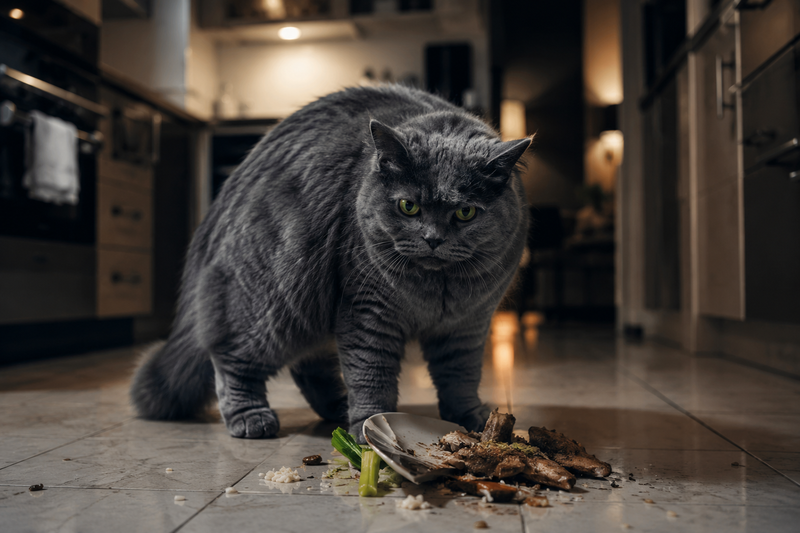
The gray cat hissed and swatted the bowl out of seven-year-old Lily's hands for the third night running, and her new stepmother demanded the animal be put down before it finally occurred to anyone to ask why the cat only ever did it at dinner.
The cat's name was Smoke, and he had been Lily's mother's cat before Lily's mother died.
When Diane married Lily's father, she made it clear from the start that she was not a cat person. Smoke was old, she said. Smoke shed. Smoke gave her the creeps the way he sat on the stairs and watched her. But Lily loved him — he was the last warm thing left from before, the cat who'd slept on her mother's hospital bed and then on Lily's pillow every night since the funeral — so Lily's father, anxious to keep peace in a grieving house, let the cat stay.
For a while there was no trouble. Then Diane started cooking.
She was very devoted about it. She insisted on making Lily's dinner herself, a special plate, separate from the grown-ups' — building the child's strength, she said, the poor motherless thing. Lily's father thought it was a kindness. He thought a lot of things Diane did were kindnesses.
The first night Smoke went after the bowl, everyone called it a fluke. The cat had darted between Lily's legs as she carried her plate to the table and knocked it clean out of her hands, and the whole dinner went across the kitchen floor. Diane was furious. Lily cried. Her father cleaned it up.
The second night, Smoke did it again — only this time he planted himself in front of Lily's chair and would not let her near the plate, back arched, hissing, swatting, drawing blood on the back of her hand when she reached past him.
"That animal is dangerous," Diane said, white-lipped. "It attacked her. You saw it. It needs to be put down before it does worse."
"He's never done this before," Lily's father said, shaken. "He's the gentlest —"
"Tomorrow," Diane said. "First thing. The vet, or I'm taking Lily to my sister's where it's safe."
The third night, Lily's father sat at the table and watched.
He watched Diane carry the special plate to the child. He watched Smoke uncoil from the stairs the instant the plate appeared, fur on end, and throw himself between the bowl and the little girl — not at Lily, he saw now, never at Lily. At the food. The old cat smacked the bowl out of her hands and stood over the spilled mess and hissed, low and continuous, his eyes fixed on the plate as if the plate were a snake.
Only Lily's plate. Never the grown-ups'.
Something cold turned over in Lily's father's chest.
"Get the cat out of here," Diane said tightly. "Tonight. I mean it."
But he was already on his knees. Not to clean up. He was looking at the spilled food on the floor — and at Smoke, who had eaten off that kitchen floor for fifteen years and would not now touch a single grain of it, who sat back from it and stared at the man as if to say finally, finally, what took you so long.
Lily's father scraped what he could into a sandwich bag.
He didn't sleep that night. In the morning, before Diane was up, he drove the bag to a lab three towns over — a friend from his fishing club ran it — and asked, feeling like a madman, like a man accusing the air, whether anything was in it.
There was.
Antifreeze. Ethylene glycol, the report said, in a quantity a vet would later call "more than sufficient, administered over a week, to take the life of a child."
It is sweet, antifreeze. Children will eat it. It does not smell or taste of anything a person would notice in a strongly seasoned dish.
But a cat will smell it. A cat knows. Smoke had smelled it the first night, and the second, and the third, and had thrown his old body between the poison and the girl every single time, and had been condemned to die for it by the woman who'd put it there.
The rest happened fast, the way these things do once they break open. Diane had a dead first husband two states away, a life insurance policy, a pattern that a detective recognized inside an hour. She had married a widower with a grieving child and a paid-off house and a fat survivor's benefit, and she had been one more dinner away from making that house her own.
She is in prison now. She will be for the rest of her life.
Lily's father has never stopped thinking about the third night — about how close he came to driving the cat to the vet that morning instead of the food to the lab. How the gentlest creature in the house had been screaming the truth at the top of its lungs for three days, in the only language it had, and how everyone had decided the cat was the danger.
Smoke is seventeen now. He sleeps on Lily's pillow every night, the way he slept on her mother's, the last warm thing from before and the reason there is still an after.
Lily is nine. She makes her own dinner some nights, simple things, eggs and toast, and she always sets a little of it aside on a saucer first and puts it on the floor before she takes a bite.
She waits for the gray cat to smell it. To look up at her. To not hiss.
Only then does she eat. She says it's just something she does now.
Her father never tells her to stop.
No comments yet. Be the first reader to comment on this story.