
For eighteen years, the answer was always the same three words: We can't afford it.
Lena heard them when she asked for new sneakers. When the other girls went on the class trip without her. When she wanted a birthday party like a normal kid. Her mother, Rosa, said them quietly, eyes down, hands raw and red from whatever job she'd just come home from — the diner, the laundromat, the office building she cleaned after midnight.
They lived in a cramped two-room apartment in Queens, and her mother was almost never in it. Rosa left before Lena woke and came home after she'd fallen asleep. To a teenager, that added up to one simple, ugly conclusion: a mother who didn't care.
So at eighteen, Lena packed a duffel bag and left a note on the counter. I'll do better on my own.
She didn't look back. She didn't see Rosa standing behind the laundromat window across the street, watching her only daughter walk away, soap still drying on her cracked hands.
Ten years passed.
Lena built exactly the life she'd promised herself. A good job downtown. A clean apartment with nothing borrowed in it. A phone that never lit up with her mother's number — because she had made sure of that, too. When people asked about her family, she said there wasn't much to tell.
Then, on an ordinary Tuesday, a hospital in Queens called.
Rosa was gone. Her heart had simply stopped, the nurse said gently, somewhere in the middle of a double shift. She had still been wearing her apron when they found her.
Lena drove back to the old neighborhood to clear out the apartment and sell whatever was worth selling. The whole way there, she told herself she felt nothing at all.
The place was exactly as she remembered. Small. Worn. Too quiet, in a way that pressed on her chest. She filled trash bags without letting herself slow down — old coats, chipped dishes, a calendar three years out of date.
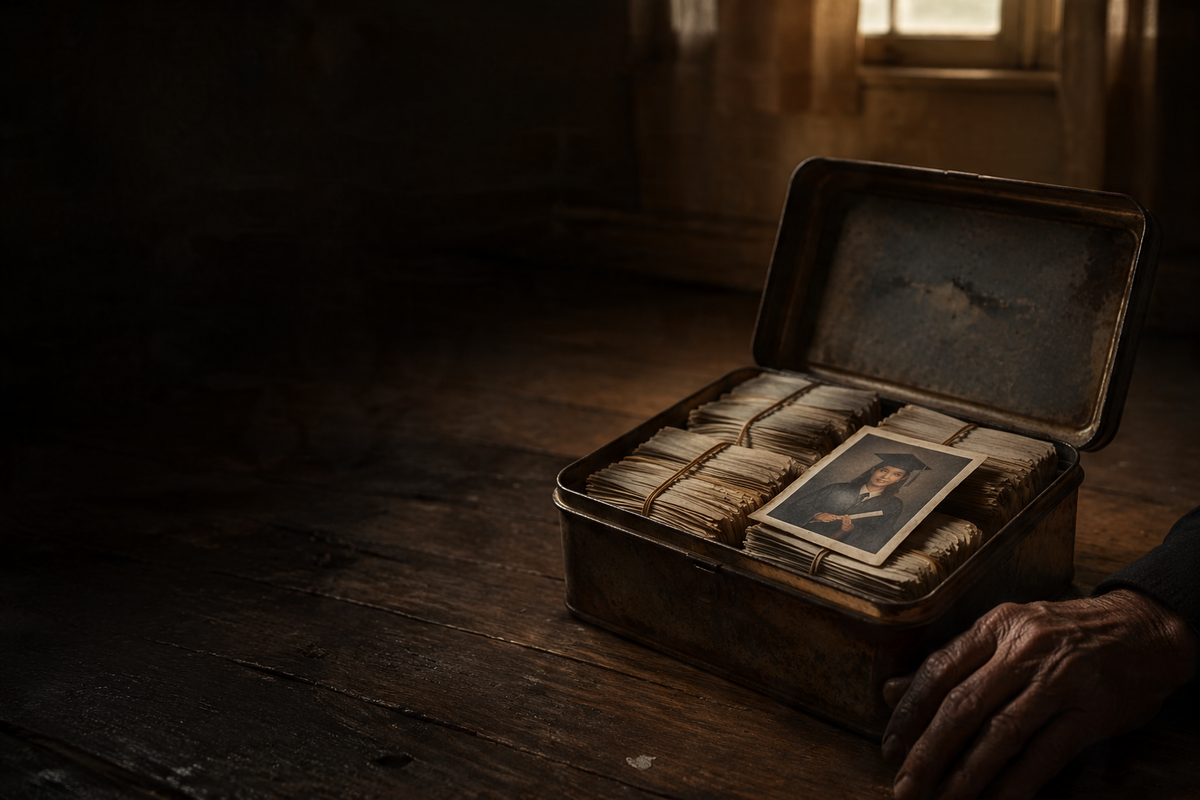
Then, reaching under the bed, her hand caught on a loose floorboard. Behind it was a tin box, the kind that once held holiday cookies. It was locked.
She pried it open with a screwdriver.
Inside were receipts. Hundreds of them. Money-transfer slips, bundled neatly by year with rubber bands, going back further than she could make sense of. And every single one was made out to the same place:
Saint Bridget's Academy.
The private boarding school in Connecticut. The one Lena had attended on a scholarship — the scholarship she'd been so proud of, the one she'd bragged about, the one that had let her escape Queens in the first place.
She turned the slips over in her hands, and the floor seemed to tilt.
There had never been a scholarship.
She sat down on the bare wooden floor of her dead mother's apartment and went through them one at a time. The dates lined up — every one of them — with the nights Rosa had not come home. The diner. The laundromat. The midnight cleaning crew. Three jobs. For eighteen years. So that the payments to Saint Bridget's would never, ever stop.
We can't afford it, her mother had said. About sneakers. About a birthday party. About every small thing a daughter ever asked for.
Because every dollar had already been spoken for. Quietly. Without a word. Without thanks.
Lena's hands were shaking now.
At the very bottom of the box, beneath the last bundle, was a single photograph.
It was her. In her cap and gown, on the day she graduated from Saint Bridget's. She remembered that afternoon clearly — remembered scanning the bright lawn full of proud families, and feeling something almost like relief that her mother hadn't bothered to come.
But the photo wasn't taken from that lawn.
It was shot from far away, through the diamond gaps of a chain-link fence, slightly crooked — the angle of someone standing outside the gate. Someone who hadn't been allowed in.
Or who hadn't let herself walk in.
Tucked behind the photo was a folded note, written in Rosa's careful, unsteady hand.
Mija — I stood outside every ceremony. I didn't go in because I was ashamed of my uniform, and I never wanted you to be ashamed of me. You were never meant to know any of this. I only needed one thing: for you to go further than I ever could. And you did. That was always enough for me. It was everything.
For a long time, Lena couldn't move.
She thought of every closed door she'd slammed. Every call she'd let ring out. Every year she'd spent certain that the silence between them meant her mother didn't love her — when all along, that silence had been the sound of a woman working through the night so her daughter would never have to.
She pressed the note to her chest in the empty apartment. And for the first time in her life, she said the word out loud.
"Mom."
To a woman who could no longer hear it.
Outside, across the street, the laundromat window was dark. But if she let herself, she could almost see her there — soap on her hands, half a smile, watching her go.
The way she always had.
No comments yet. Be the first reader to comment on this story.