
The case was supposed to be nothing.
Petty theft. A no-name defendant. A thin file Nadia could read in the elevator on the way up. She took it the way she took all of them lately — fast, efficient, already thinking about the next one.
She was twenty-nine, three years into the public defender's office in downtown Los Angeles. Ambitious enough to resent the small cases. Good enough to win them anyway.
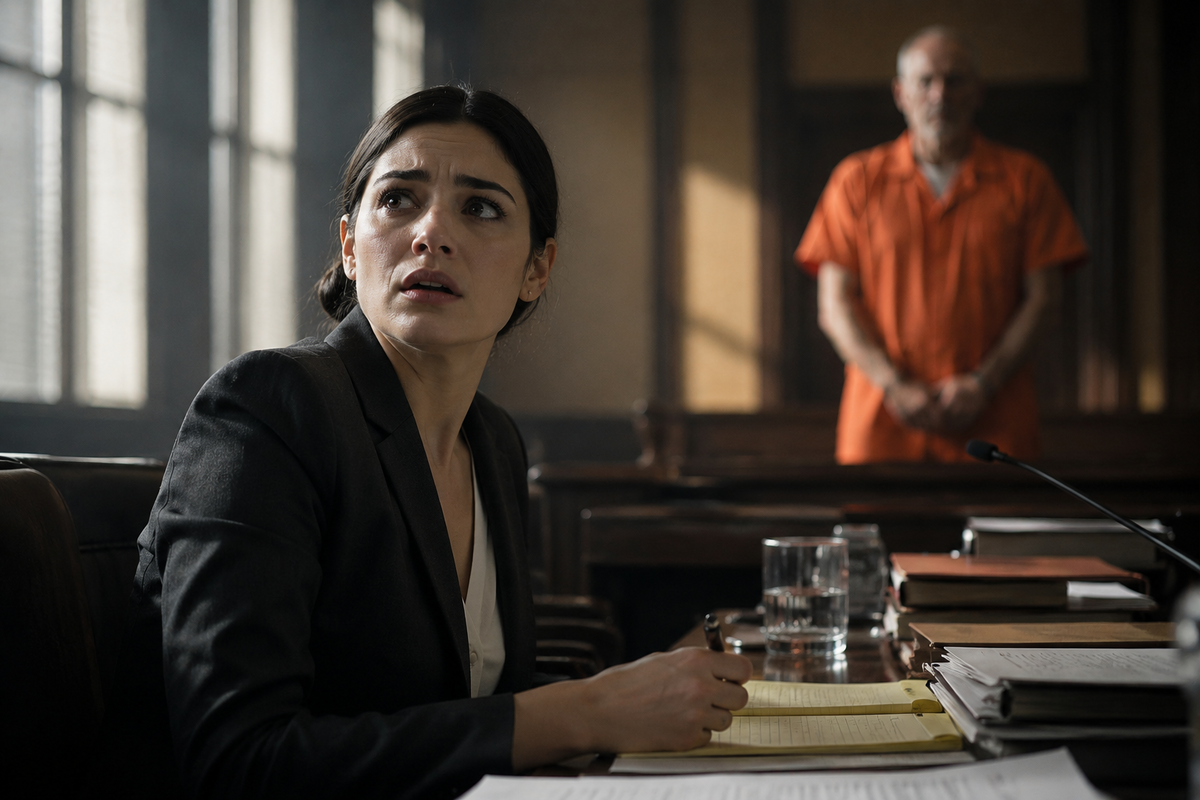
She didn't even look up when the guard brought the defendant in. She was still scanning the file.
"State your name for the record," the clerk said.
"Frank Mercer," the man answered.
Nadia's pen stopped moving.
She knew that voice. She would have known it anywhere — even after twenty-two years.
She looked up, and the floor seemed to drop away beneath her chair.
The man in the orange jumpsuit, hands cuffed in front of him, greyer and thinner and worn down to almost nothing, was her father. The man who had walked out of her life when she was seven years old and never come back.
He looked straight at her.
And he didn't recognize her at all.
Every rule she had told her to walk into her supervisor's office and ask off the case. Conflict of interest. Her own sanity. There were a dozen reasons, all of them good.
Instead, that night, she went down to the holding cells.
She kept her voice flat. Professional. She asked him about the charge — a shoplifting accusation, one small item taken from a pawnshop counter.
"I didn't steal it," he said quietly. "I was going to pay. I just didn't have enough yet." He looked down at his cuffed hands. "It was meant to be a gift. For my daughter."
Nadia's throat closed. "You have a daughter?"
"Had," he said. "A long time ago. I don't even know where she is now." A pause, and something broke faintly in his voice. "Her name was Nadia."
She should have told him then. She couldn't. She didn't trust herself to say a single word.
So instead she did what she was good at. She dug.
The "stolen" item, logged into evidence, was a thin silver bracelet — cheap, the kind you'd find in any mall kiosk. She requested it from the evidence room and turned it over in her gloved hands at midnight, alone under the buzzing lights.
On the inside of the band, in tiny engraved letters, was a single word.
NADIA.
She pulled the old records next. Her father's name, traced back twenty-two years. And what she found rearranged everything she had spent her whole life believing about the man who had abandoned her.
Frank Mercer hadn't just left.
He had run.
He'd owed money to dangerous people — the kind who hurt people to make a point. And when they had started watching the house, started asking neighbors about his wife, about his little girl, he had done the only thing he could think of to keep them safe. He vanished. He changed his name. He took every threat in his life and carried it away from his family, one city at a time.
For twenty-two years he had been a ghost. Working under the table. Sleeping in rented rooms. Alone — so that the danger would follow him, and never them.
He had never stopped being her father. He'd only had to do it from somewhere she couldn't see.
The morning of the trial, the prosecutor was relaxed, certain. An easy conviction. A man with no fixed address and a bracelet he couldn't prove he'd paid for.
When her turn came, Nadia rose. But she did not make the argument anyone in that courtroom expected.
"Your Honor," she said — and her voice shook, for the first time in three years of standing in rooms like this — "I need to disclose something to the court. And I would like to testify."
The room went still. The judge leaned forward.
"This man," Nadia said, "is my father."
A murmur swept the gallery. Frank's head came up slowly, his eyes finding her face, searching it, beginning — finally — to understand.
She laid it out piece by piece. The bracelet had not been stolen. It had been set aside on layaway and paid down with the last of his wages, engraved weeks earlier with the name of a daughter he hadn't seen since she was seven years old. She produced the pawnshop's own layaway record — the one the prosecution had never bothered to pull.
A gift is not a theft.
The charge collapsed before lunch.
They stood together afterward on the courthouse steps, in the flat white Los Angeles sun. Two strangers who were not strangers at all, twenty-two years standing between them like a wall neither one knew how to climb.
Frank looked at her the way a man looks at something he had given up ever seeing again.
"It was you," he said. "In there. It was you the whole time."
Nadia couldn't make her voice work. So she didn't try. She just held out her wrist.
His hands trembled as he fastened the thin silver bracelet around it — the gift twenty-two years late, the one that had nearly sent him to prison.
"I'm so sorry," he whispered. "I came so late."
Nadia looked down at her own name resting against her wrist, finally where it had always been meant to be.
And for the first time since she was seven years old, she let herself reach out and take her father's hand.
"It's okay, Dad," she said. "There's still time."
No comments yet. Be the first reader to comment on this story.