
There is a kind of man who is gentle when he is sure of himself and cruel when he is not, and Grant Holloway had never in his life been less sure of himself than he was the night he came to meet Sofia's family.
He arrived twenty minutes early on purpose. He always did, before the things that frightened him. Arriving first let him choose the seat, set the tone, be the man already comfortable when everyone else walked in — and tonight he needed that more than usual, because tonight he was meeting Tomas Vianello.
Vianello's sat on a corner the city had grown up around: warm yellow light spilling onto a wet sidewalk, the name in old gold script above the door, steam ghosting from the kitchen vents into the cold. Inside it was full and alive in the way only a restaurant that has been loved for forty years can be — close tables, the clatter of plates, a wall of black-and-white photographs running the whole length of the room, families and decades and a city changing behind them. It smelled of garlic and woodsmoke and bread. It was not what Grant had pictured. Sofia had always called it "my family's place," and Grant, who heard what he wanted to hear, had pictured something small, something he could be impressed by in a generous, condescending way. This was not small. This was the kind of place that did not need him at all, and that frightened him too.
He was thirty-four, handsome in the careful, effortful way of men who study it — a good jaw he kept clean-shaven, dark hair cut every two weeks, a navy suit a half-size too sharp for a Saturday dinner. He wore his nerves the way such men do, by becoming a little louder, a little more certain, a little more entitled to the room. Eight months he had been with Sofia. Eight months building, quietly, on the thing he never said out loud even to himself: that Sofia came from something, that her father had built something, and that a man who married into it would never have to be afraid again. He had a ring in his breast pocket. He meant to do it tonight, in front of all of them. He meant to be unforgettable.
The girl who came to his table was young, twenty-one or so, slight, with dark hair pinned up off a quick warm face and a pen tucked behind her ear. She moved through the crowded room the way you move through a place you have known your whole life, sideways, easy, a hand on the back of a regular's chair as she passed. She set down bread and oil and a candle and smiled at him.
"Can I start you with something to drink while you wait?"
"You can start," Grant said, "by getting me a table that isn't next to the kitchen door."
"Oh — this is actually the table reserved for the Vian— for the party of six tonight, the best one in the—"
"Did I ask for a tour?" He didn't look up from his phone. "Sparkling water. No ice. The good kind, not whatever you pour for everyone else."
She brought it. He sent it back, said it was flat, which it wasn't. She brought another. He watched her walk away and felt, in the watching, a small ugly flicker of something better than his fear: power. Here, at least, was a person beneath him. Here, at least, was someone he could be certain about.
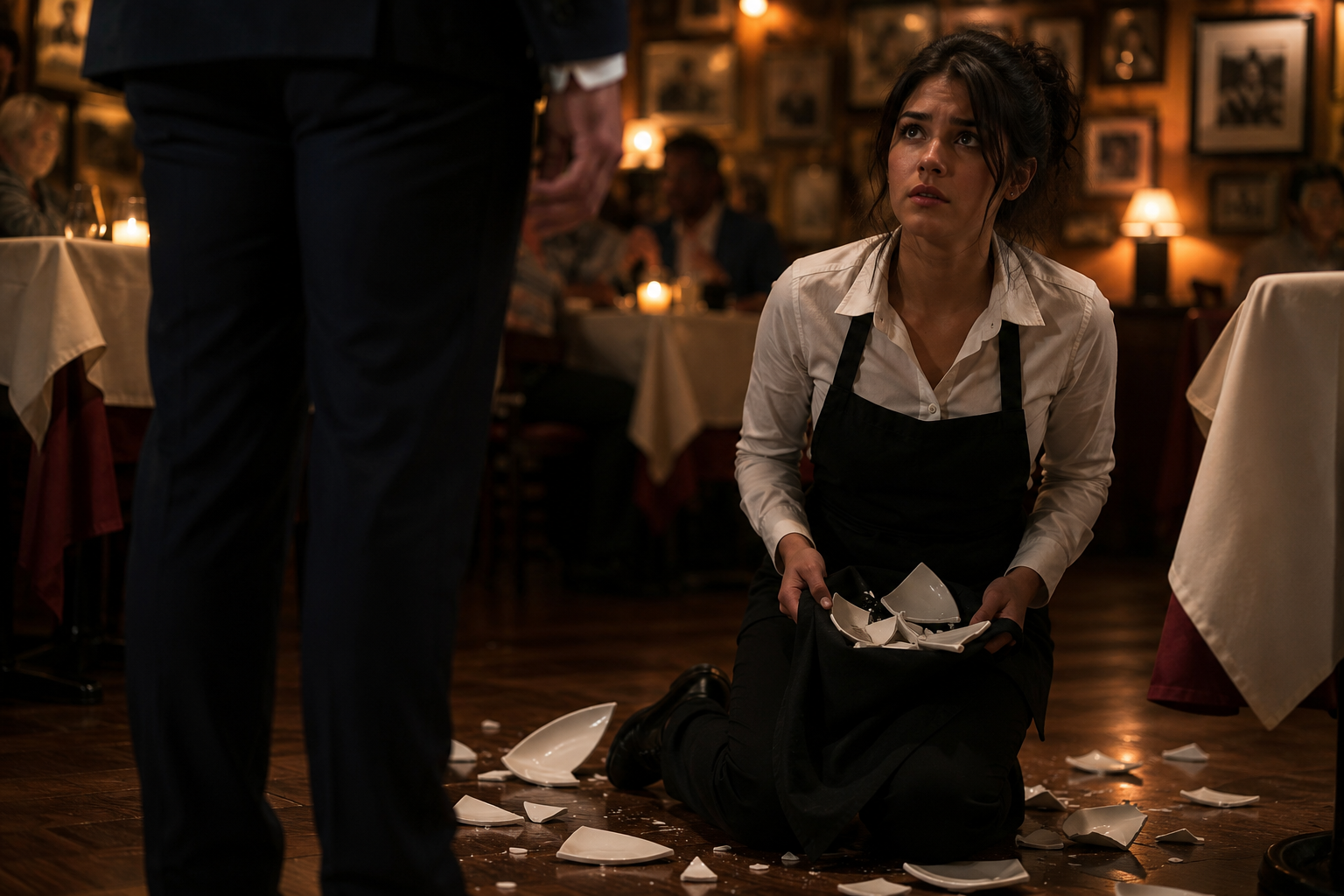
It built the way these things build. He snapped his fingers for her twice. He corrected her, loudly, about a dish she had described exactly right. When she set down the antipasto he'd ordered to look busy, he picked up the plate, examined it like a man inspecting something a dog had brought him, and let it drop from six inches above the table. It cracked. Olives rolled. A young couple two tables over went quiet.
"I'm so sorry," the girl said, already crouching, "let me get—"
"You'll get on your knees, is what you'll do." His voice had found the room now, that carrying boardroom flatness. "You'll clean up what you ruined. And while you're down there—" he leaned back, addressing the tables around him, performing for an audience he could win "—you might think about how a place like this lets just anyone carry a plate. No training. No breeding. No future." He took out his phone and turned the camera on her, on her knees in the broken china. "This is going online, sweetheart. This is the face of why service in this city is dead."
"Please," she said quietly, gathering shards into her apron, "please don't film me."
"You want me to stop?" He laughed. "I could buy this place. You understand that? I could buy this whole sad little restaurant and have you out the door by morning, and tomorrow you'd be carrying plates somewhere worse, because that's all you'll ever do. That's the whole story of you. I can see it from here."
A waiter started forward from the bar; an older man at the register lifted a hand and stopped him, his eyes not on Grant but on the girl, his jaw working. Grant didn't notice. Grant was looking at the screen of his phone, at the small kneeling figure framed in it, at himself winning.
"Say sorry to the room," he said. "Properly. Say: I'll do better. Say it loud enough that the cheap seats can hear y—"
The door opened.
Cold air and street noise and four people coming in out of the rain, and the first of them was Sofia, beautiful, laughing at something, shaking the wet from her coat — and her laugh died in her throat. She did not look at Grant. She did not see Grant at all. She crossed the room in five fast steps and dropped down beside the girl on the floor.
"Gia." Her hands on the girl's face, on her shoulders, on the apron full of broken plate. "Gia, what happened, what—"
"It's nothing," the girl whispered. "I'm fine. Sof, I'm fine, please—"
Grant's phone was still recording. He had not yet understood. "Sofia—" he started, with a smile that did not know it was already dead, "—babe, you made it, I was just—"
"This is my sister."
The words did not seem to mean anything to him at first. He looked at the girl on her knees. He looked at Sofia kneeling beside her. He looked, for the first time all night, at the long wall of photographs behind his own chair — the family through forty years, christenings and anniversaries and a restaurant being built brick by brick — and there, in every single frame, was the same dark-haired girl growing up year by year. The girl he had put on the floor. He had been sitting with his back to her whole life and had not seen any of it.
The fourth person through the door was a broad old man with grey at his temples and flour, somehow, still on the cuff of his good shirt, because he had been in the kitchen of this restaurant that afternoon as he was every afternoon. He did not hurry. He came to stand over the table, over the broken plate and his two daughters on the floor and the phone still glowing in Grant's hand, and Grant felt the temperature of the whole room settle onto him at once.
"Mr. Holloway." Tomas Vianello's voice was low and unbothered, the voice of a man who had thrown larger men than Grant out of larger rooms than this. "Sofia has talked about you for eight months. I have looked forward to this." He glanced, once, at his younger daughter, then back. "You wanted to meet the man who built all of this. You've been performing for him all night. You just didn't know which chair he was in."
"Sir—" The smile was gone now, the navy suit suddenly a costume on him. "It was a misunderstanding, the girl—your daughter—I didn't—"
"You did." Tomas did not raise his voice; he never had to. "You did it loudly, and you filmed it, and you told my child she had no future while she knelt in front of you. You wanted to know if you were good enough to join this family." He let it sit, and the whole quiet restaurant let it sit with him. "You've spared us all a great deal of time."
Sofia stood. She helped her sister up first, an arm around her, before she turned to the man she had loved for eight months. She did not shout either. She just looked at him for a long moment, the way you look at something you finally see clearly, and then she held out her hand, palm up.
"Whatever's in your pocket," she said. "I think we both know it's not going to happen."
He did not give her the ring. He could not seem to make his hand move at all. So she simply turned and walked her sister toward the kitchen, toward the warm light and the people who loved her, and the room slowly, deliberately, returned to its dinner — the clink of glasses, the low talk, forty years of it closing back over the silence like water over a stone.
Grant Holloway sat alone at the best table in the house, the table that had been set for six, in a restaurant he now understood he would never be welcome in again. The candle burned. The bread went cold. And behind him, all along the wall he had never once turned to look at, the girl he had called nobody smiled out of forty years of photographs — at her christening, at her first communion, on her father's shoulders the day the doors first opened — in the place that had always, every single night, been hers.
No comments yet. Be the first reader to comment on this story.