
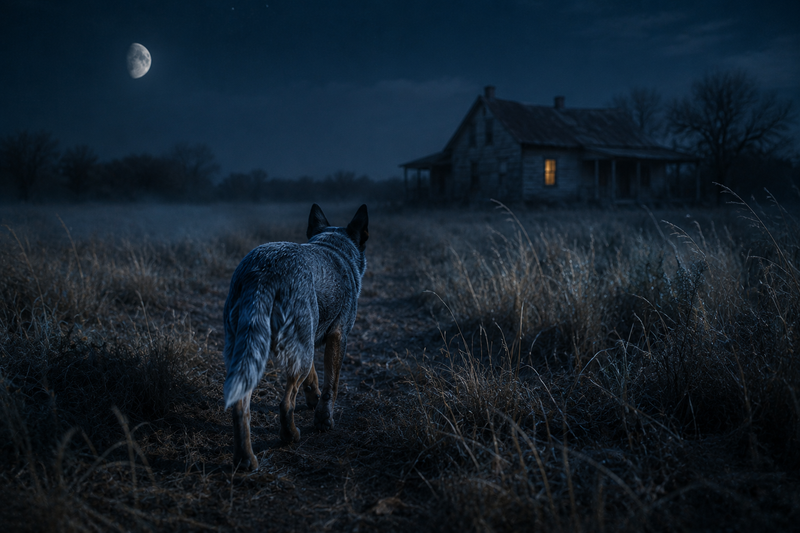
Every night at dusk the farm dog slipped under the fence and disappeared until dawn, and Russ Tilley had finally decided to shoot him for it when his daughter asked to come along and see where the dog really went.
The dog's name was Scout. He was a blue heeler, four years old, the best stock dog Russ had ever run — and the most disloyal animal he'd ever owned.
Russ ran two hundred head of cattle on dry ground east of Sutter Creek, and a good heeler was worth more than a hired man. By day Scout was perfect: tireless, smart, glued to Russ's heel. But the moment the sun touched the ridge, the dog changed. He'd go to the south fence, look back once at the house, and squeeze under the bottom wire into the dark. Every night. Gone till sunup.
Russ took it personally. A dog that ran off all night was a dog with one foot out the door — a dog that'd take up with coyotes, or get a taste for somebody's chickens, or just up and leave for good. He'd patched the fence three times. Scout always found a way.
"He's no good," Russ told his wife. "A dog you can't trust at night is a dog you can't trust. I won't keep one that won't stay."
His daughter Nell was eleven and quiet and loved that dog more than she loved most people. When she heard her father say he'd put Scout down if it happened one more time, she didn't argue. She just said:
"Take me with you tonight. Before you do it. I want to see where he goes."
So Russ took the rifle and his daughter and they sat in the truck at the south fence at dusk with the lights off, and they waited.
Scout came at the usual time. He went to the fence, looked back once at the dark house, and squeezed under the wire. Russ started the truck and followed him with the headlights off, bumping slow across the open ground under a half-moon, his daughter's small face pressed to the glass.
The dog trotted a mile and a half, across Russ's land and onto the old Hadley place next door — a sagging house Russ had assumed was empty since the bank took it. He hadn't known anyone still lived there.
But there was a light on. One window, dim and yellow.
Scout went to the back porch, scratched twice at the door, and the door opened.
An old man stood there in the lamplight, bent nearly double over a walker, and his whole ruined face lit up like a boy's.
"There he is," the old man said. "There's my fella. Right on time."
Russ killed the engine and sat very still.
Through the open door he could see inside the little house — and what he saw was a man living alone at the bottom of his life. Eldon Hadley. Russ knew the name now, a rancher from the generation before his own, a widower, no children left in the county. A man everyone assumed had gone to a home years ago, because nobody had thought to check.
Scout went in. The old man lowered himself into a chair by the cold stove with the terrible slowness of the very old, and the dog climbed up and lay across his feet and his lap both, all sixty pounds of him, and the old man put his shaking hands into the dog's coat and bent his face down into it and stayed like that a long while.
"I don't know whose you are," Eldon said to the dog, his voice carrying thin across the yard. "You showed up in the fall when my Bess died. First warm thing in this house since. I'd have froze in my sleep more'n once if you didn't come keep the chill off these old legs. Don't know how you know to come. But you come every night, and I make it to morning on account of you."
Nell was crying without a sound. Russ found he couldn't speak.
His best dog, his disloyal dog, the dog he'd come out here to shoot — had spent every night of the winter walking a mile and a half in the dark to keep a forgotten old man alive.
That was the loyalty Russ had been calling betrayal. Not loyalty to Russ. Loyalty to something Russ hadn't even known was out there in the dark needing it.
He got out of the truck. He left the rifle on the seat.
He walked up to the porch with his hat in his hands, and the old man startled, and Russ said, "Evening, Mr. Hadley. I'm your neighbor, Russ Tilley. I believe that's my dog. And I believe I owe you a great deal of catching up."
He came every day after that. Brought groceries, firewood, a propane heater, his wife's casseroles. Got Eldon's road plowed and his name on the county's list for help that should've reached him years before. And every night, he stopped patching the south fence.
He left the bottom wire loose on purpose.
Scout still went. Russ let him. A good dog knows things a man takes years to learn — that loyalty isn't staying where you're told. It's going where you're needed, even in the dark, even when no one understands, even when the man with the rifle has it wrong.
Eldon Hadley lived two more winters, warm ones, and was never alone in them.
When he passed, it was in his sleep, in the chair by the stove, with a blue heeler across his feet keeping the chill off his old legs to the very end.
Russ buried him proper. And he never once, for the rest of that dog's life, asked Scout to stay home at night.
No comments yet. Be the first reader to comment on this story.